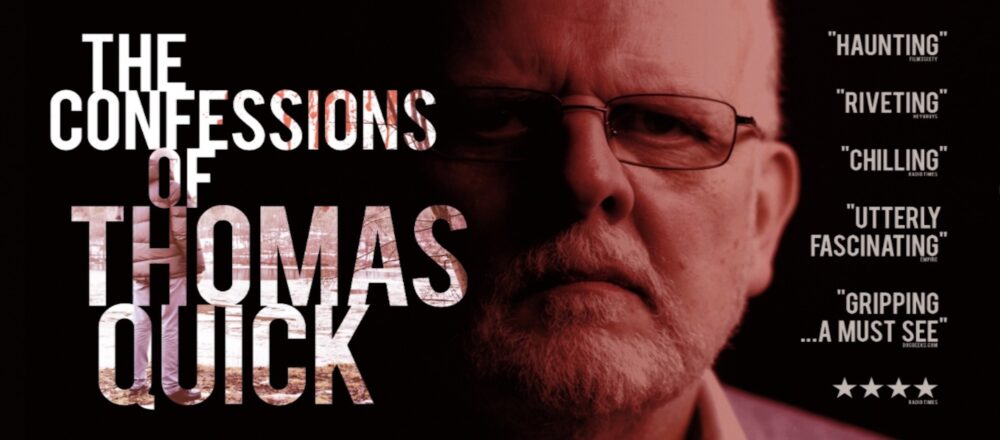
The Confessions Of Thomas Quick
Directed By: Brian Hill
Film 4, BFI, Picturehouse Feature documentary.
OFFICIAL SELECTION Rome Film Festival
OFFICIAL SELECTION Sheffield International Film Festival
OFFICIAL SELECTION CPH:Dox
OFFICIAL SELECTION International Documentary Festival Amsterdam
In a high-security psychiatric clinic sits Thomas Quick, Sweden’s most notorious serial killer. A misfit loner who openly confessed to a range of unspeakable crimes including rape, murder and cannibalisation, Quick’s story has shocked and haunted the Swedish nation for over 20 years. However, new evidence including testimony from the man himself has taken this terrifying story in an even more disturbing direction. With full access to Quick, this real life thriller unravels the truth behind a self-confessed serial killer and uncovers a dark tale of murder and lies.
The opening sequence juxtaposes a combination of slightly gothic / romantic expressive lyrical strings with dark atmospheric sound design and music textures to illustrate Thomas's intellligent calculating serial killer mind with the innocent human victims. Throughout the film the use of voice and brass with sliding pitch bends over Thomas's facial close-ups (and the end of the opening sequence) represents his descent into insanity. The use of trombone and brass also reflects the cold bleak Nordic setting as well as his loneliness. Finnish accordion provide unusual rhythmical textures injecting energy and pace as well as discordance. Classical & modern minimalist piano and strings themes are used for the cerebral 'intelligent' psychiatrists through the film.
MUSIC AWARDS
2016 MUSIC + SOUND AWARDS UK
WINNER Best Original Feature Film Score
2016 WOMEN IN SYNC AWARDS (USA)
NOMINEE Best Music In A Feature Film
THE MAKING OF THE SCORE
The score had to be quite cinematic, to have an expansive feel in places, and to be very moody, dark and atmospheric which was quite intimate at times contrasting with quite dramatic dynamic moments such as the Bank manager hostage scene.
The tricky approach we had was how to avoid overly manipulate the audience’s perception of Thomas…to avoid steering the audience. We wanted to make you feel that you were dealing with a monster here - one of the world’s most notorious serial killers… but then 2/3 of the way through the film, our impression of him had to shift to being, not sympathetic, but certainly have a feeling of ambivalence and being impartial.
On an emotional level - Thomas’s / Sture’s journey and story was incredibly immersive - I would ponder and ruminate on ideas during the day but the actual creative writing happened at night. The score is quite thematic with regards to the locations and the different characters…there is a 4 note motif for Thomas that appears a lot throughout the film and instrumentally , we wanted to use some unusual sounds.
CHARACTER THEMES
SATER - we created a theme for Sater the high security asylum which has a clean, pure, sterile feel at the beginning of the film which develops into an eerie, angular and metallic theme.
THOMAS - has a little returning motif
SEPPO PENTINAN - Seppo Pentinan - is almost like a balletic dance between the game / the relationship between Seppo and Thomas
JENNY - the journalist has a positive recurring warm, light theme
BIRGITTA STAHLE, MARGIT NORRELL - the psychiatrists have slightly cerebral piano based themes to describe their brilliant minds.
There are moment of grotesque horror when he talks about his childhood
We knew we didn't want to bring in traditional Scandi folk instruments - it was too obvious - and we didn't want cliches. So we had fun using instruments in an unconventional way - such as the human voice, Finnish Accordion, and a sense of slightly bleak minimalism. We also integrated Nordic Brass blended with a small string ensemble and sound design.
INSTRUMENTS
ACCORDION:
For example, we brought in Antti Palaanen , a Finnish Accordionist - recorded remotely 500km NW of Helsinki who has developed a technique on the accordion called the Breath Box. We discovered him 4 years ago in Copenhagen at a music conference / showcase expo where he gave a mesmerising performance - transforming the accordion into almost a ‘breathing monster’ and we knew instantly that he would be perfect for the film - he provides a textural and rhythmic organic backbone to the score such as the gay stabbing scene, or several of the scenes where Thomas is being driven to the reconstruction locations.
HUMAN VOICE
Thomas’s inner voice , if you like, is represented by a female voice - that ethereal fragile mental state contrasting with unstable eeriness but also bringing a very human quality to this supposedly cold, calculating character.
We didn’t want to go over dramatise it… and hopefully it is most effective when you see the long lingering shots of Thomas looking straight at you down the camera lens.
We used a lot of sliding notes & pitch bends to represent the descent into an unstable mental state which is used throughout the film but you can hear in the forest poem reading scene.
THE SONG: THE LONELINESS INSIDE
We felt we couldn’t really complete Thomas’s story without writing a song for him.
The song is our fictionalised account of Thomas’s reasons and state of mind for his actions, because the crux , the heart of the film touches upon loneliness.
We had three recording sessions in the Faroe Islands and Copenhagen with Eivor Palsdottir the Faroese / Scandinavian singer who is a remarkable performer - a contemporary, folk, trained soprano who also encompasses traditional nordic styles. I was introduced to her songs a year ago. I was so blown away by the authenticity and integrity of her singing we though she would be able to express were looking for an excuse to work with her on a suitable project.
We wanted the song to have a brooding, dark, atmospheric feel but it evolved into something much more powerful and emotional than we were expecting.
FILM REVIEWS
"Plenty of thrillers employ third act twists to keep the mystery going. But the one used in the serial killer documentary, The Confessions of Thomas Quick is so good it’s hard to believe it’s true."
Hollywood Reporter
"Compelling serial killer doc."
Lesley Felperin, The Guardian.
"A fascinating portrait of a troubled man and true crime case file"
Ben Nicholson, CineView
"utterly fascinating"
Empire, Patrick Peters